- Same-day UK dispatch on orders before 3pm
- Certificate status shown on every product
- Shop all research peptides
- Learn: guides and research tools
TB-500
In stock10 mg
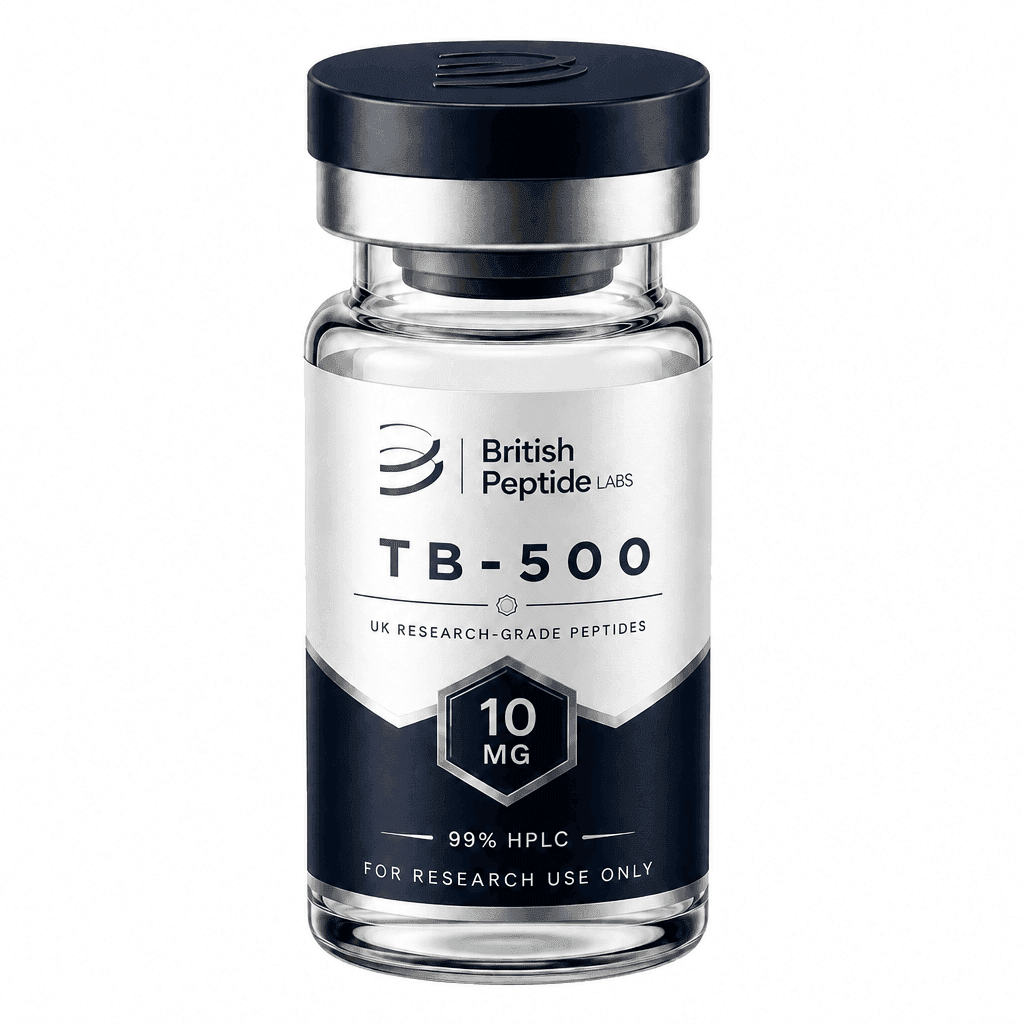
£75.00
Research area
For research use only. Not for human or veterinary use. Sold strictly for in-vitro laboratory research; not for diagnosis or treatment.
This research area gathers linear synthetic peptides and co-lyophilised blends of them. The single peptides are chains of standard amino acids without cyclisation or lipidation, so their identity rests on residue count, sequence and molecular formula rather than on side-chain chemistry. BPC-157 is a pentadecapeptide, Gly-Glu-Pro-Pro-Pro-Gly-Lys-Pro-Ala-Asp-Asp-Ala-Gly-Leu-Val, with the formula C62H98N16O22 and a molecular weight of 1419.53 g/mol; four of its fifteen residues are proline. TB-500 corresponds to thymosin β4, a single chain of forty-three residues (C212H350N56O78S). A blend has no single formula or CAS number. Linear peptides of this kind are usually characterised by reversed-phase HPLC together with mass spectrometry against the expected mass. Each product in this area is supplied as a lyophilised solid in a sealed vial, with its identifiers listed on the product page where they are known.
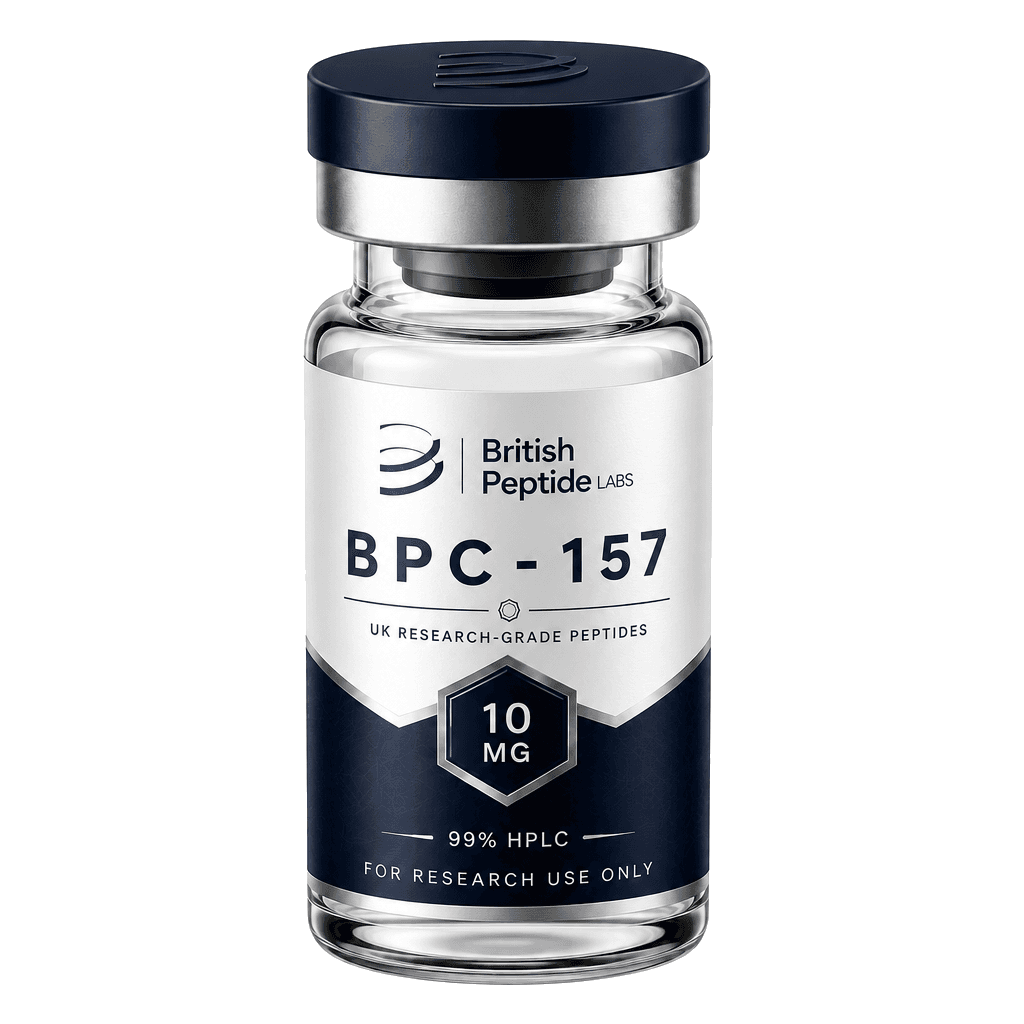
In stock10 mg
In stock10 mg
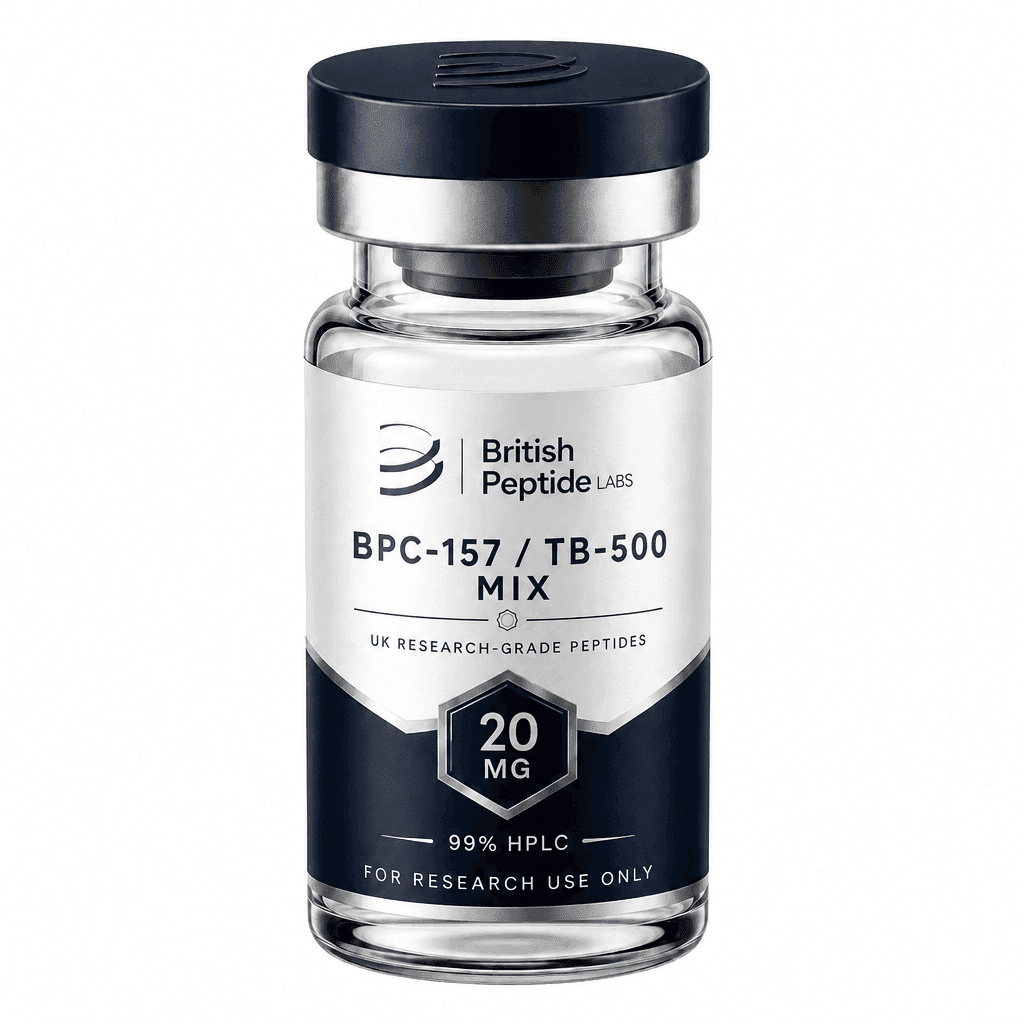
In stock20 mg blend
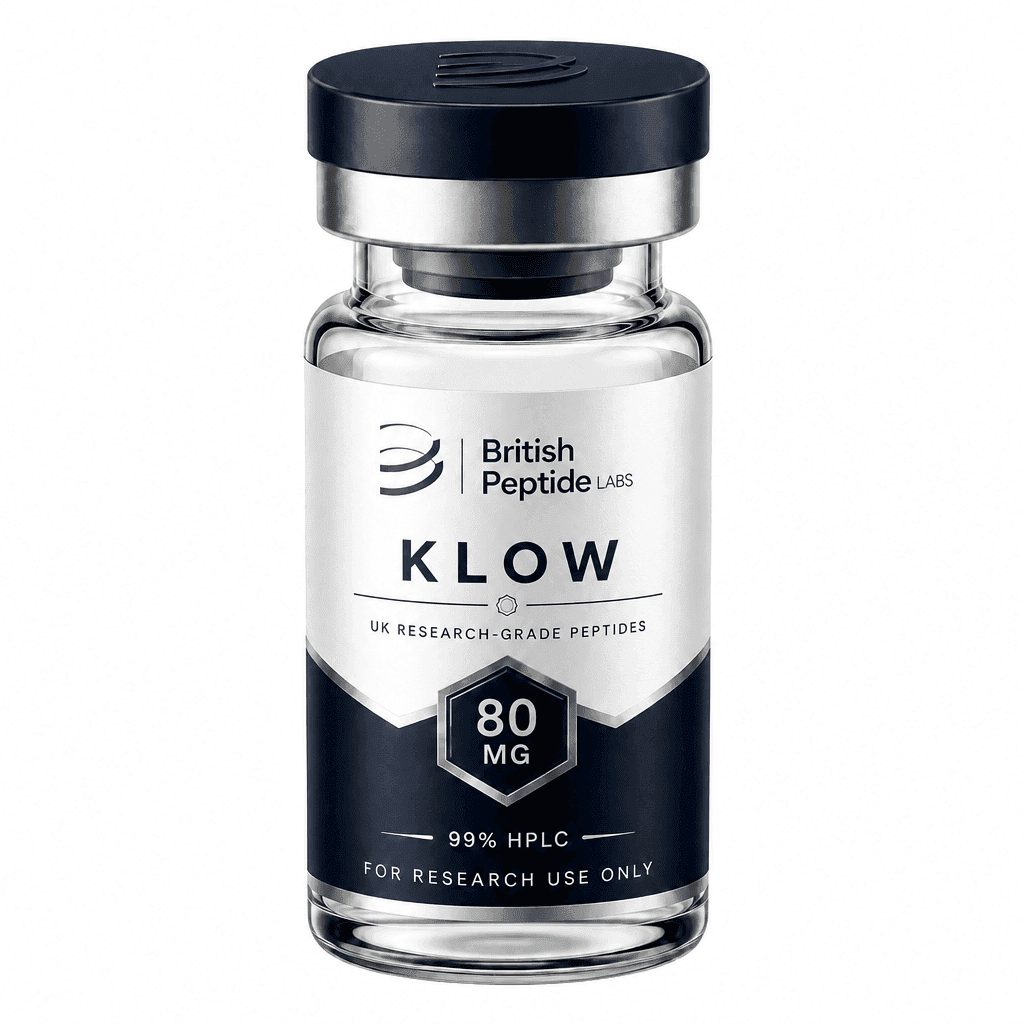
In stock80 mg blend
The single peptides in this research area are linear chains without cyclisation or lipidation, so their identity rests on residue count, sequence and molecular formula. BPC-157 shows the pattern clearly. Its fifteen residues, H-Gly-Glu-Pro-Pro-Pro-Gly-Lys-Pro-Ala-Asp-Asp-Ala-Gly-Leu-Val-OH, are all standard amino acids, with a free amine at the N-terminus and a free carboxylic acid at the C-terminus. Four of the fifteen are proline, three of them consecutive, and proline's ring restricts the conformations the backbone can adopt around it. The chain carries three acidic side chains, one glutamate and two aspartates, against a single lysine.
TB-500 is catalogued as a synthetic peptide corresponding to thymosin β4, a single chain of forty-three residues. The CAS number, formula (C212H350N56O78S) and molecular weight listed for it are those of that full-length chain, and at 4963.44 g/mol it is about three and a half times the mass of BPC-157. The listed formula contains a single sulfur atom.
The blends in this area are co-lyophilised: two or more peptides dried together into a single solid in one vial. A blend has no single molecular formula, CAS number or molecular weight. It is specified instead by naming its components, each with its own identifiers, and by the combined net content of the vial. Where a split between components is stated, it is a separate figure from that combined net content.
| Compound | CAS number | Molecular formula | Molecular weight |
|---|---|---|---|
| TB-500 | 77591-33-4 | C212H350N56O78S | 4963.44 g/mol |
| BPC-157 | 137525-51-0 | C62H98N16O22 | 1419.53 g/mol |
Short, unmodified linear peptides are well suited to reversed-phase HPLC with ultraviolet detection at around 214 to 220 nm, where the peptide bond absorbs. BPC-157 has no tryptophan, tyrosine or phenylalanine, so it has almost no absorbance at 280 nm and detection relies on the peptide-bond region. Its acidic character makes retention sensitive to mobile-phase pH and to the ion-pairing agent, and proline-rich sequences can show broadened or split peaks where cis and trans forms of the prolyl bonds interconvert slowly on the timescale of the separation.
Mass spectrometry confirms identity against the expected mass: 1419.53 g/mol for BPC-157, while a chain the length of TB-500 appears as a series of multiply charged ions that are deconvoluted to a neutral mass. For a blend, one chromatogram shows a peak for each component, so the method has to resolve the components from one another and from each component's own related substances, and figures are reported per component rather than for the vial as a whole. Each component's identity is confirmed separately by its mass, because retention time alone cannot show which peak is which. Typical related substances across the area are deletion sequences, in which one residue is missing, and truncated chains from incomplete coupling during synthesis.