- Same-day UK dispatch on orders before 3pm
- Certificate status shown on every product
- Shop all research peptides
- Learn: guides and research tools
GHK-Cu
In stock50 mg
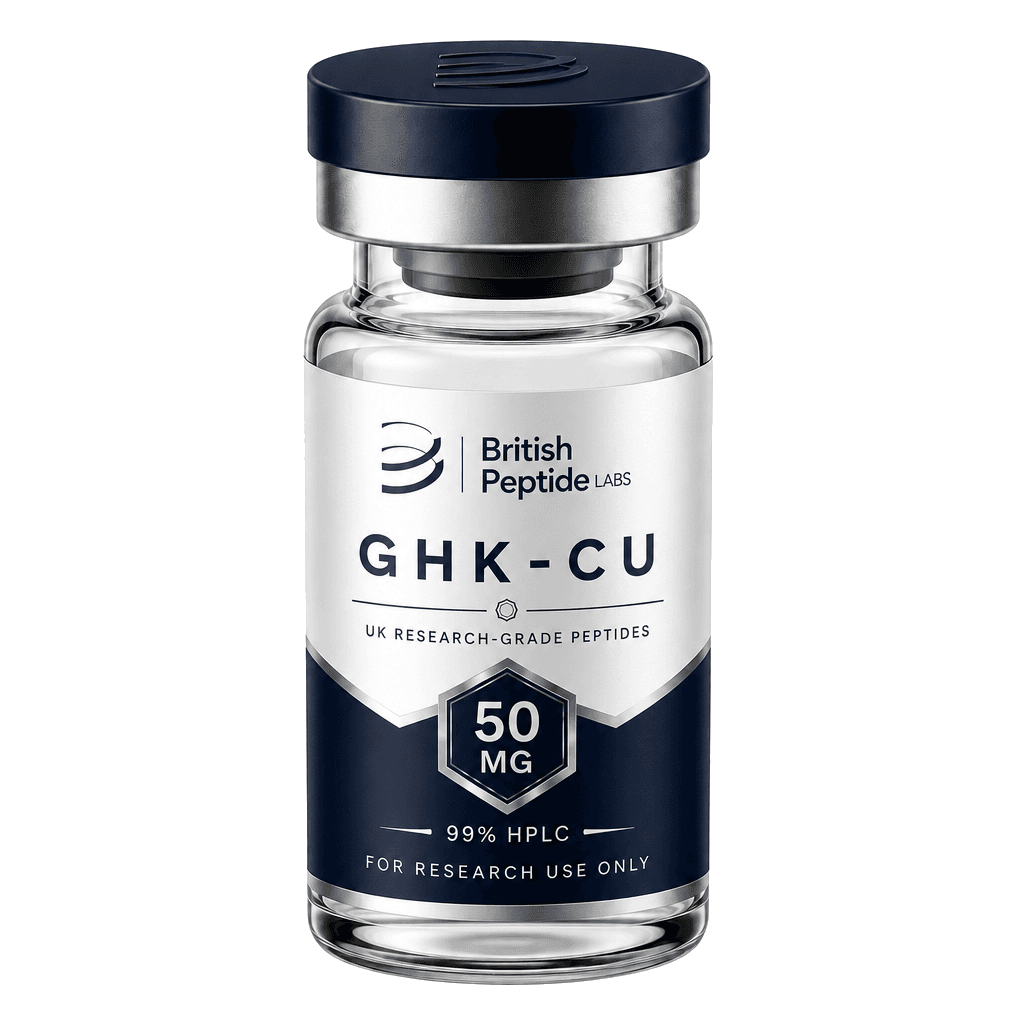
£20.00
Research area
For research use only. Not for human or veterinary use. Sold strictly for in-vitro laboratory research; not for diagnosis or treatment.
Two structurally distinct families of short peptides share this research area. The first comprises cyclic heptapeptide ligands of the melanocortin receptor family. In each, a lactam bridge between the side chains of an aspartic acid and a lysine residue closes a ring of six residues, leaving an N-terminal acetyl-norleucine outside it; the ring also contains a D-phenylalanine. The two catalogued here differ at the C-terminus, one ending in an amide and the other in a free acid (C50H69N15O9 and C50H68N14O10). The second family is GHK-Cu, the copper(II) complex of the tripeptide glycyl-L-histidyl-L-lysine, C14H22CuN6O4, in which the metal ion is coordinated by nitrogen atoms of the glycine amine, the peptide backbone and the histidine imidazole. Identity for both families is typically established by mass spectrometry.
The two cyclic heptapeptides in this area share one ring. Written out, the core sequence is Ac-Nle-cyclo[Asp-His-D-Phe-Arg-Trp-Lys]: a lactam (amide) bond between the side-chain carboxyl of aspartic acid and the side-chain amine of lysine closes a ring of six residues, and N-acetyl-norleucine sits outside the ring at the N-terminus. Norleucine is a non-proteinogenic isomer of leucine with an unbranched four-carbon side chain, and D-phenylalanine is the ring's one D-configured residue.
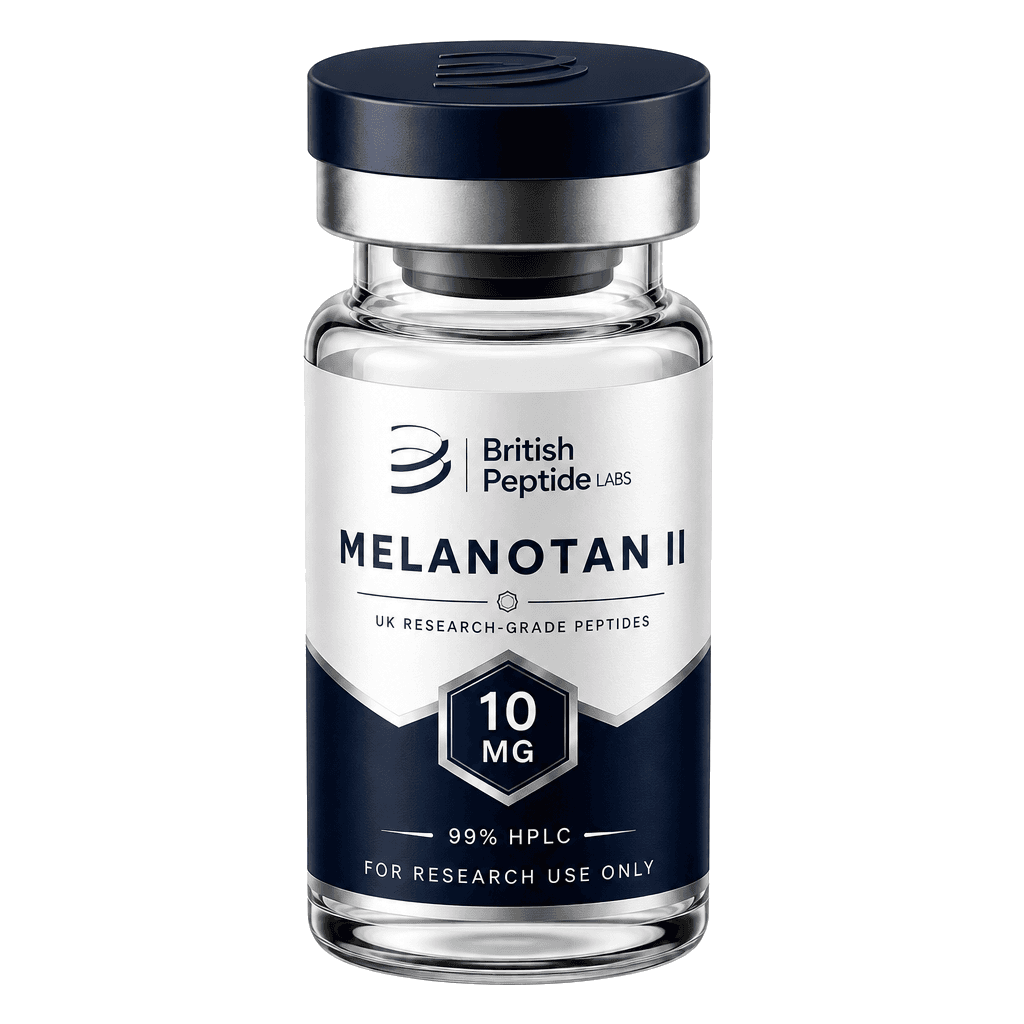
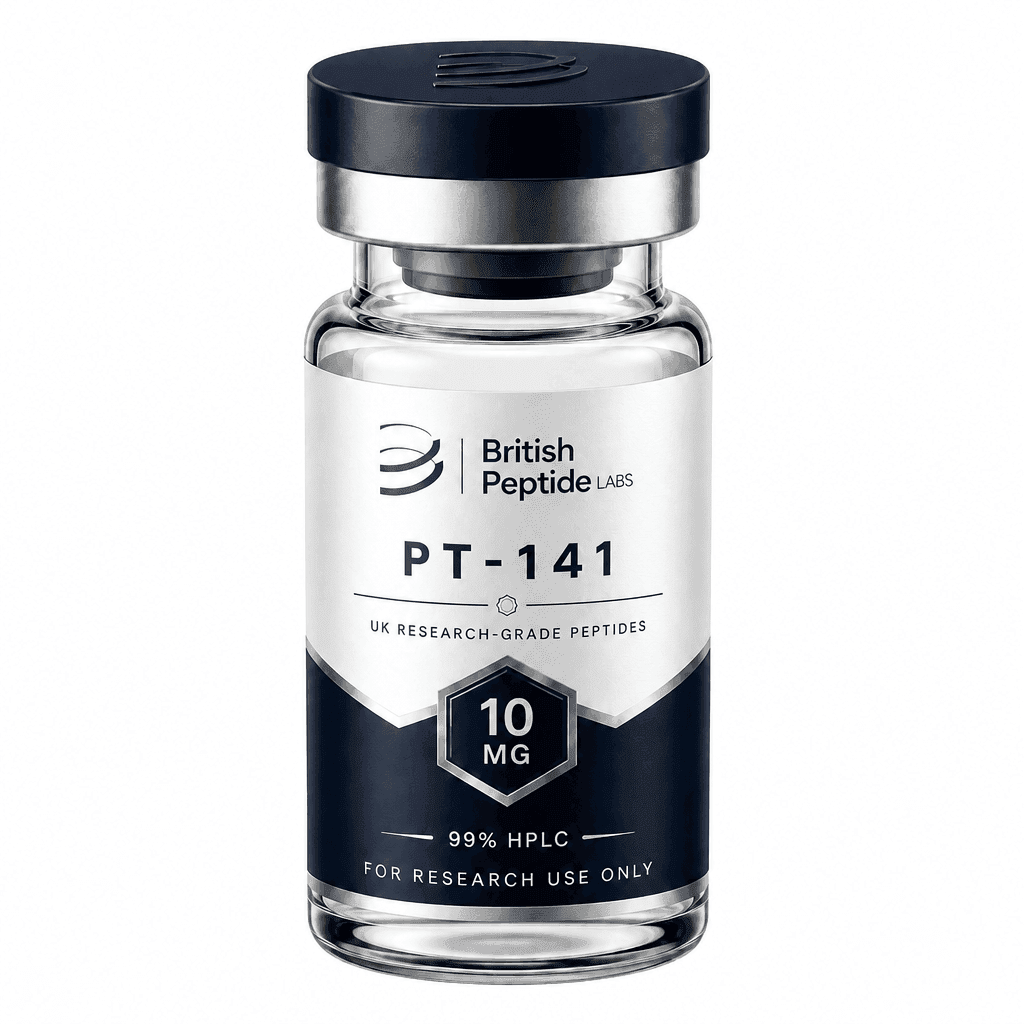
The two differ only at the C-terminus. One ends in a lysine amide (C50H69N15O9, 1024.18 g/mol) and the other in a free carboxylic acid (C50H68N14O10, 1025.18 g/mol). Exchanging NH2 for OH changes the formula by one nitrogen, one hydrogen and one oxygen, and the mass by about 1 Da, which is small enough that the pair has to be told apart deliberately rather than assumed.
GHK-Cu belongs to a different family. It is the copper(II) complex of the tripeptide glycyl-L-histidyl-L-lysine; the free tripeptide has the formula C14H24N6O4, and the complex listed here, C14H22CuN6O4, holds one copper ion per peptide. That formula has two hydrogen atoms fewer than the peptide and copper combined, consistent with a neutral complex of Cu(II) with the doubly deprotonated peptide. At three residues, GHK is the shortest peptide chain in the catalogue. In complexes of this kind the copper is typically bound by the N-terminal amine, a backbone amide nitrogen and a nitrogen of the histidine imidazole ring.
| Compound | CAS number | Molecular formula | Molecular weight |
|---|---|---|---|
| GHK-Cu | 89030-95-5 | C14H22CuN6O4 | 401.91 g/mol |
| MT2 | 121062-08-6 | C50H69N15O9 | 1024.18 g/mol |
| PT-141 | 189691-06-3 | C50H68N14O10 | 1025.18 g/mol |
For the cyclic heptapeptides, forming the lactam bridge eliminates one molecule of water, so a cyclised molecule is 18 Da lighter than its open-chain precursor. That difference is a convenient mass-spectrometric check that cyclisation is complete. Tryptophan in the ring absorbs at 280 nm, giving a second ultraviolet window alongside the peptide-bond region around 214 nm, and the acid and amide forms are separated by HPLC retention as well as by their 1 Da difference in mass. The arginine in the ring stays positively charged across the usual chromatographic pH range, and an acidic ion-pairing agent such as trifluoroacetic acid in the mobile phase keeps the peaks sharp.
Metal complexes need analysis of both parts. Reversed-phase separations with acidified mobile phases can strip copper from the peptide, so a chromatogram may show the free tripeptide rather than the complex, and the copper content is usually established separately, for example by elemental analysis or atomic spectroscopy. Mass spectra of copper complexes carry a characteristic isotope pattern from the two stable isotopes, copper-63 and copper-65, in a ratio of roughly seven to three, which confirms that the metal is present in the ion being measured.