- Same-day UK dispatch on orders before 3pm
- Certificate status shown on every product
- Shop all research peptides
- Learn: guides and research tools
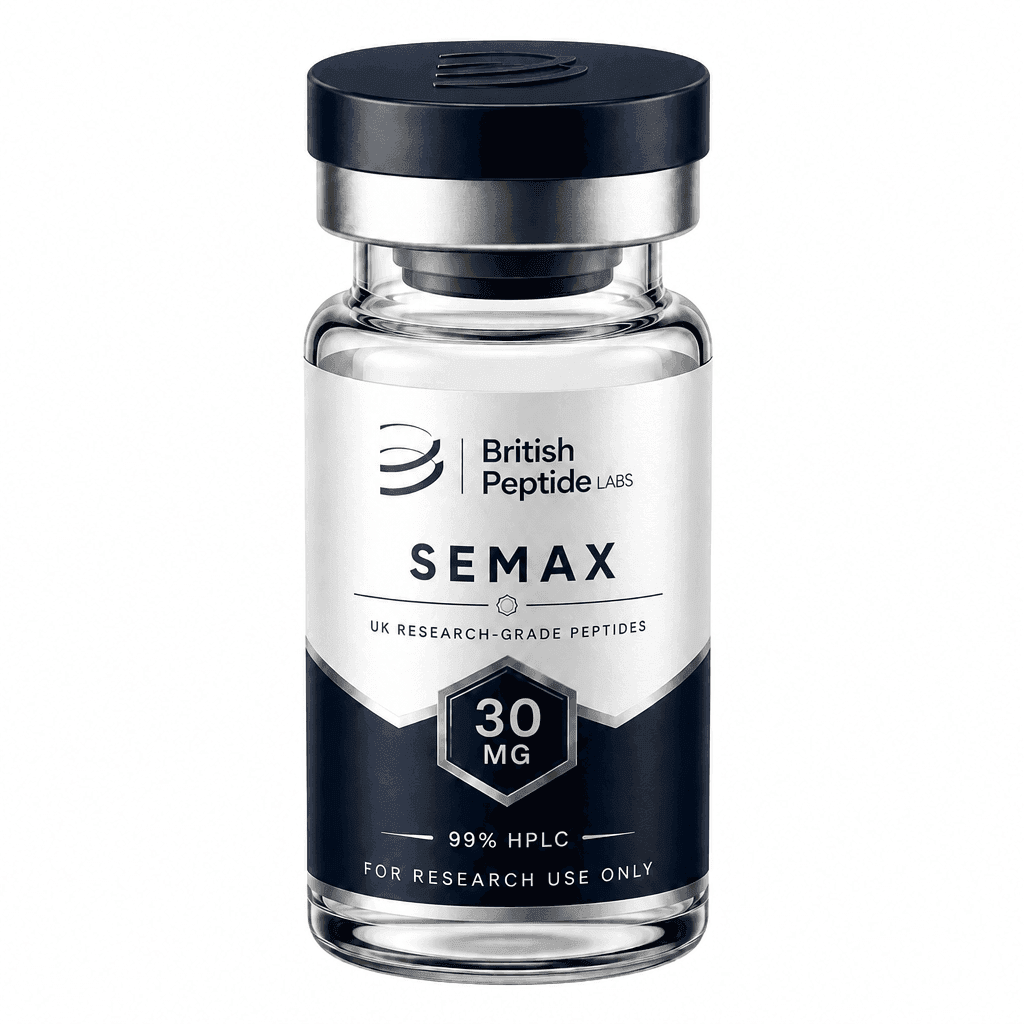
Semax
In stock30 mg
£55.00
Research area
For research use only. Not for human or veterinary use. Sold strictly for in-vitro laboratory research; not for diagnosis or treatment.
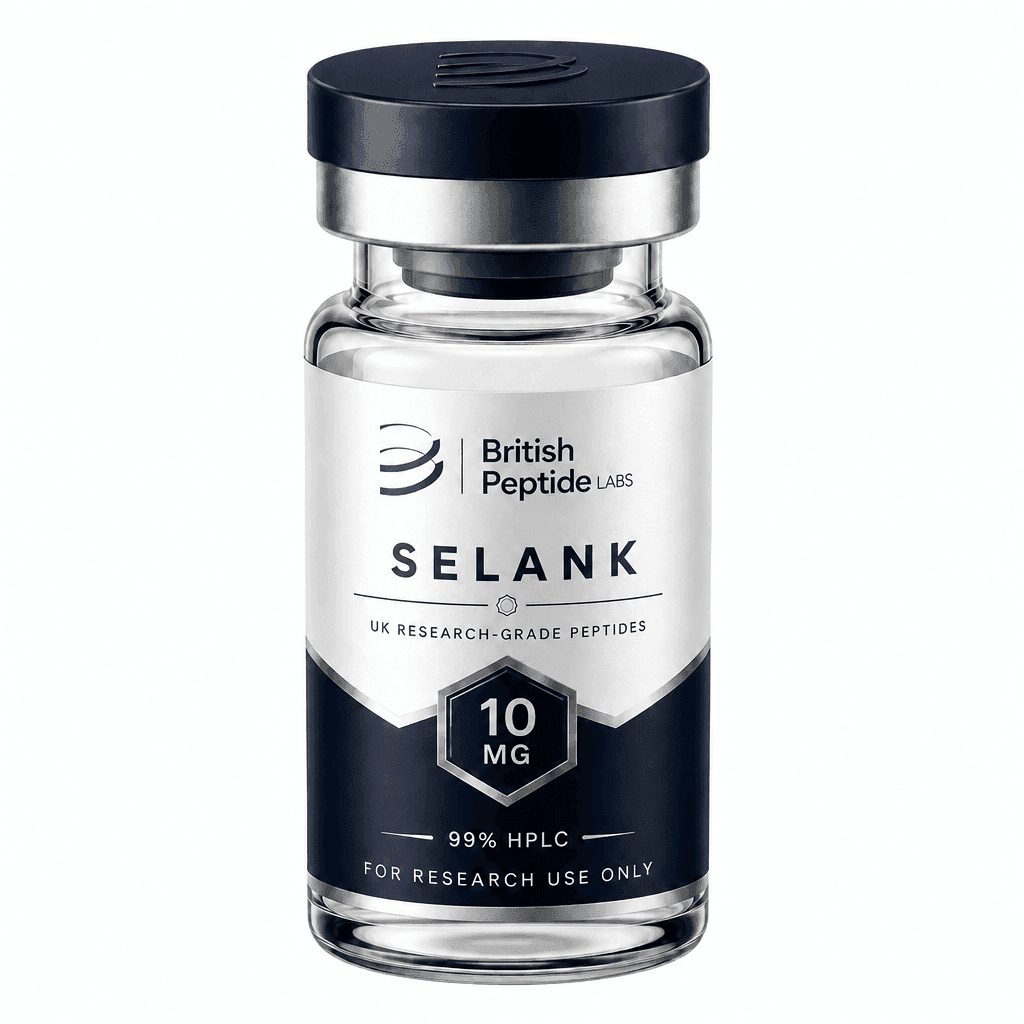
The neuropeptides in this research area are two synthetic heptapeptides built on the same design: a short sequence taken from a larger peptide, extended at the C-terminus by the tripeptide Pro-Gly-Pro. Semax, Met-Glu-His-Phe-Pro-Gly-Pro, is an analogue of ACTH(4–10) in which the fragment ACTH(4–7) carries this extension. Selank, Thr-Lys-Pro-Arg-Pro-Gly-Pro, extends the tetrapeptide tuftsin, Thr-Lys-Pro-Arg, in the same way. Both are linear chains of L-amino acids with a free N-terminus and a free C-terminal acid, and neither carries a side-chain modification. Their molecular formulas are C37H51N9O10S for Semax (813.92 g/mol) and C33H57N11O9 for Selank (751.87 g/mol), and each is supplied as a lyophilised solid in a sealed vial.
Semax and Selank are both heptapeptides assembled on the same plan: a short fragment of a larger peptide, extended at the C-terminus by the tripeptide Pro-Gly-Pro. In Semax, H-Met-Glu-His-Phe-Pro-Gly-Pro-OH, the fragment is ACTH(4–7), Met-Glu-His-Phe. In Selank, H-Thr-Lys-Pro-Arg-Pro-Gly-Pro-OH, it is the tetrapeptide tuftsin, Thr-Lys-Pro-Arg. Both have a free N-terminal amine and a free C-terminal carboxylic acid, both are built only from standard amino acids, and neither carries a side-chain modification.
The Pro-Gly-Pro extension gives each sequence a proline-rich C-terminal end. Proline's side chain loops back onto its own backbone nitrogen, so a prolyl residue has no amide hydrogen and restricts the conformations nearby, and the peptide bonds that precede proline are the ones most able to adopt the cis form. Selank contains three prolines in seven residues and Semax two. Glycine, between the two prolines of the extension, is the only achiral residue in either sequence.
The two differ in charge. Selank carries a lysine and an arginine and no acidic side chain, so it is basic overall. Semax has a glutamic acid and a histidine but no lysine or arginine, and its only sulfur atom, in the N-terminal methionine, appears in its formula, C37H51N9O10S, against Selank's C33H57N11O9. Neither contains a cysteine, so there is no disulfide bridge to confirm in either peptide.
| Compound | CAS number | Molecular formula | Molecular weight |
|---|---|---|---|
| Semax | 80714-61-0 | C37H51N9O10S | 813.92 g/mol |
| Selank | 129954-34-3 | C33H57N11O9 | 751.87 g/mol |
At 751.87 and 813.92 g/mol, both peptides sit in the range where electrospray mass spectrometry shows mainly singly and doubly charged ions, so identity can be read almost directly from the spectrum against the expected mass. Each chain contains histidine or arginine, so positive-ion electrospray gives a strong signal for both. With a free N-terminal amine and a free C-terminal acid, each also carries both a positive and a negative terminal charge at neutral pH. Their different compositions also separate them in reversed-phase HPLC: Selank, basic and without an aromatic side chain, is weakly retained, while Semax, with its phenylalanine and methionine, would be expected to elute later under the same gradient.
Each has a characteristic point to watch. The methionine of Semax can oxidise to the sulfoxide, which adds 16 Da and is a typical related substance, and its phenylalanine and histidine give it weak absorbance above 250 nm. Selank has no methionine, tryptophan or cysteine, so it offers no easy site for oxidation, and because it has no aromatic side chain its absorbance comes almost entirely from the peptide bonds, which makes low-wavelength detection around 214 nm the practical choice. Proline-rich chains of this kind can also give broadened peaks where cis and trans prolyl forms interconvert during the separation.